

A recent podcast I listened to caught my attention for two reasons.
One, the guest was Brian Reisinger. I remembered Reisinger from his time at the Wausau Daily Herald. The day I met him he was on his very first assignment for the paper, covering a story I was covering as a part-timer for City Pages.
The second reason was the topic. Reisinger was talking about artificial intelligence, and how it could impact farming. I stay very up to date on AI, up to and including reading in-depth research reports from firms such as SemiAnalysis, Citrini and A16Z.
And yet, I hadn’t thought about farming and AI.
I decided to reach out to Reisinger to see if we could have a chat about the topic. I wanted to go deeper — because I could see two ways AI could manifest. One, it could be a great leveler to help small farms compete. A low-cost technology that helps bridge the gap small farms might face when competing against large farms, which normally have an advantage because they can spend more on sophisticated equipment.
But it’s easy to see the reverse — larger farms being more open to new technology, adopting artificial intelligence systems while smaller farmers remain skeptical.
Where the technology is actually manifesting is in a way that could lean toward the latter — and that’s a concern for someone like Reisinger, whose book Land Rich, Cash Poor highlights the plight of small farms as they continue to disappear.
I also reached out to several farm educators and providers to hear more about how AI impacts, and is being used in, modern farming.
Here’s what I learned.
Standing up for the little guy

Reisinger’s family still owns a small farm in the driftless region of Wisconsin. After a nearly decade-long stint in journalism that began with the Wausau Daily Herald and led to business reporting at larger publications, Reisinger then worked on Capitol Hill, advising on campaigns and communication for U.S. Senate committees. He worked on the campaigns of Scott Walker and Sen. Ron Johnson.
But while he valued his time in the nation’s capital, ultimately it wasn’t for him, Reisinger told The Wausonian.
“My time in government taught me that, you know, the partisanship in this country isn’t helpful,” Reisinger says.
That led to work in consulting and column writing, which he does to this day. It also led to work on his book Land Rich, Cash Poor: My Family’s Hope and the Untold History of the Disappearing American Farmer. The book was named C-SPAN Author Series Most Important Book of 2024 and won the 2025 Farm Foundation Book of the Year Award.
The book highlights the history of his family farm, how his dad needed to step up and help on the farm when his grandfather broke his back, and the plight of the small farm as more and more larger farms dominate the landscape.
That leads to centralization, which is more vulnerable to supply chain disruptions among other issues, Reisinger says.
It’s something I’ve reported on before, but small farms continue to disappear from the landscape.
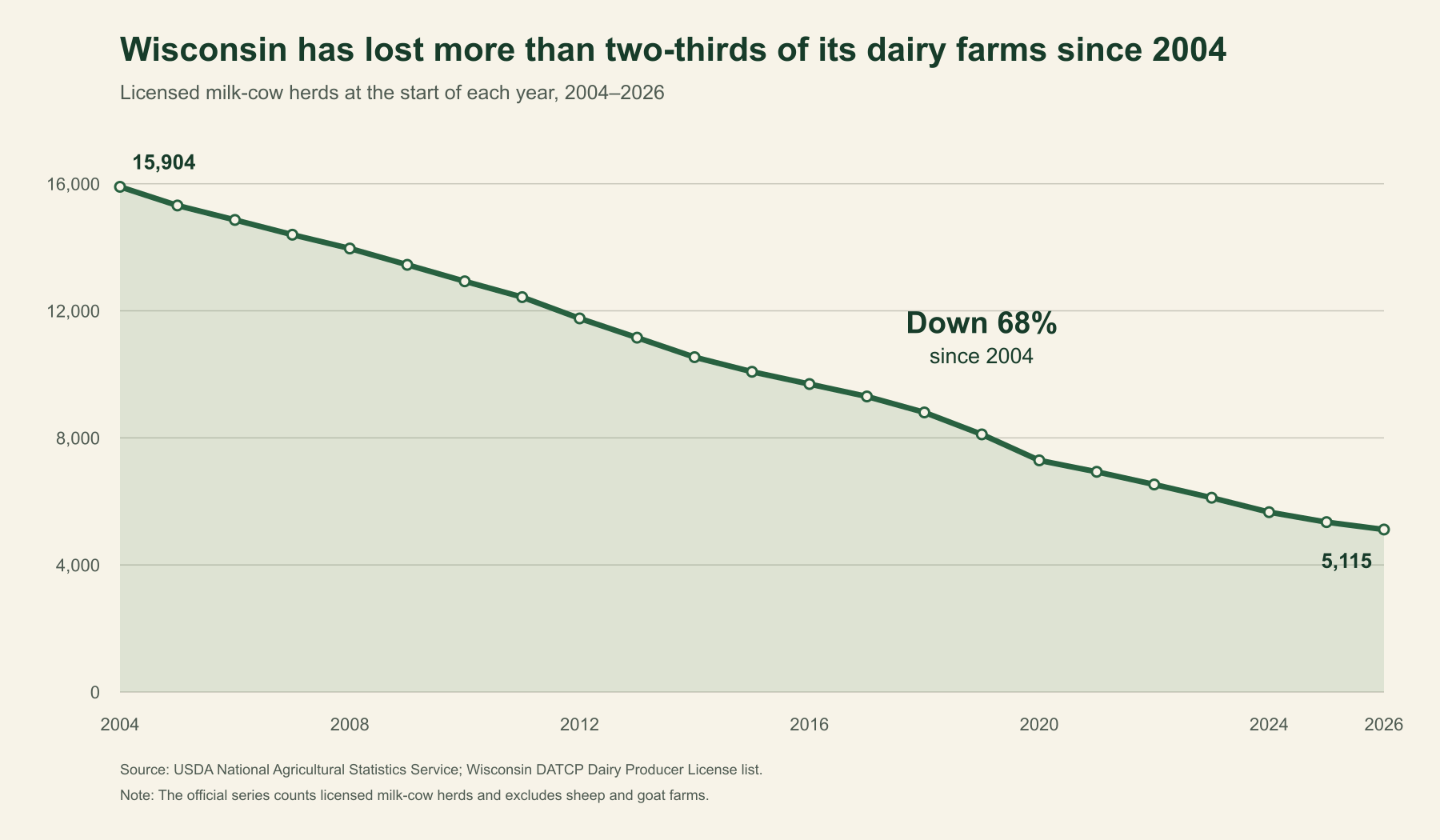
Dairy farms in Wisconsin have particularly been on the decline:
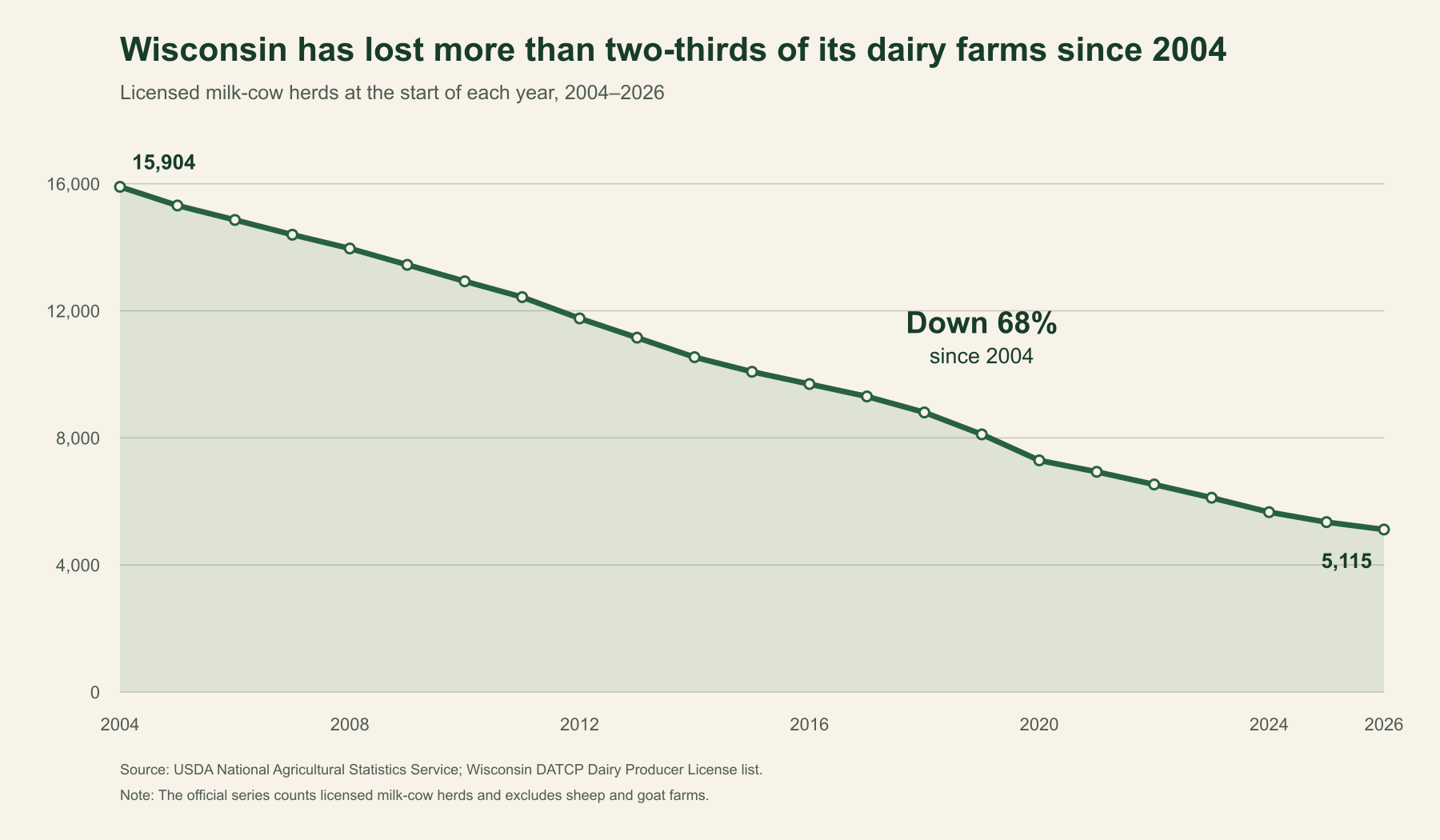
And small family farms in Wisconsin in general:
One potential way larger farms could continue to displace small farms is through artificial intelligence.
AI and the farm
I asked Reisinger about AI. I was confused by some statements in his podcast appearance, because I was thinking about AI from my own context: something that is remarkably inexpensive for what you get. (AI saved me hundreds of dollars helping me do my businesses’ taxes alone, for instance.)
So I didn’t know what he meant when he talked about AI needing to manifest in farming in a way that didn’t tip the balance in favor of the larger farmers. In other words, it needed to be neutral.
But that’s because I didn’t understand where AI is mostly showing up. Reisinger explained that in farming, AI is mostly to be found at the industry level.
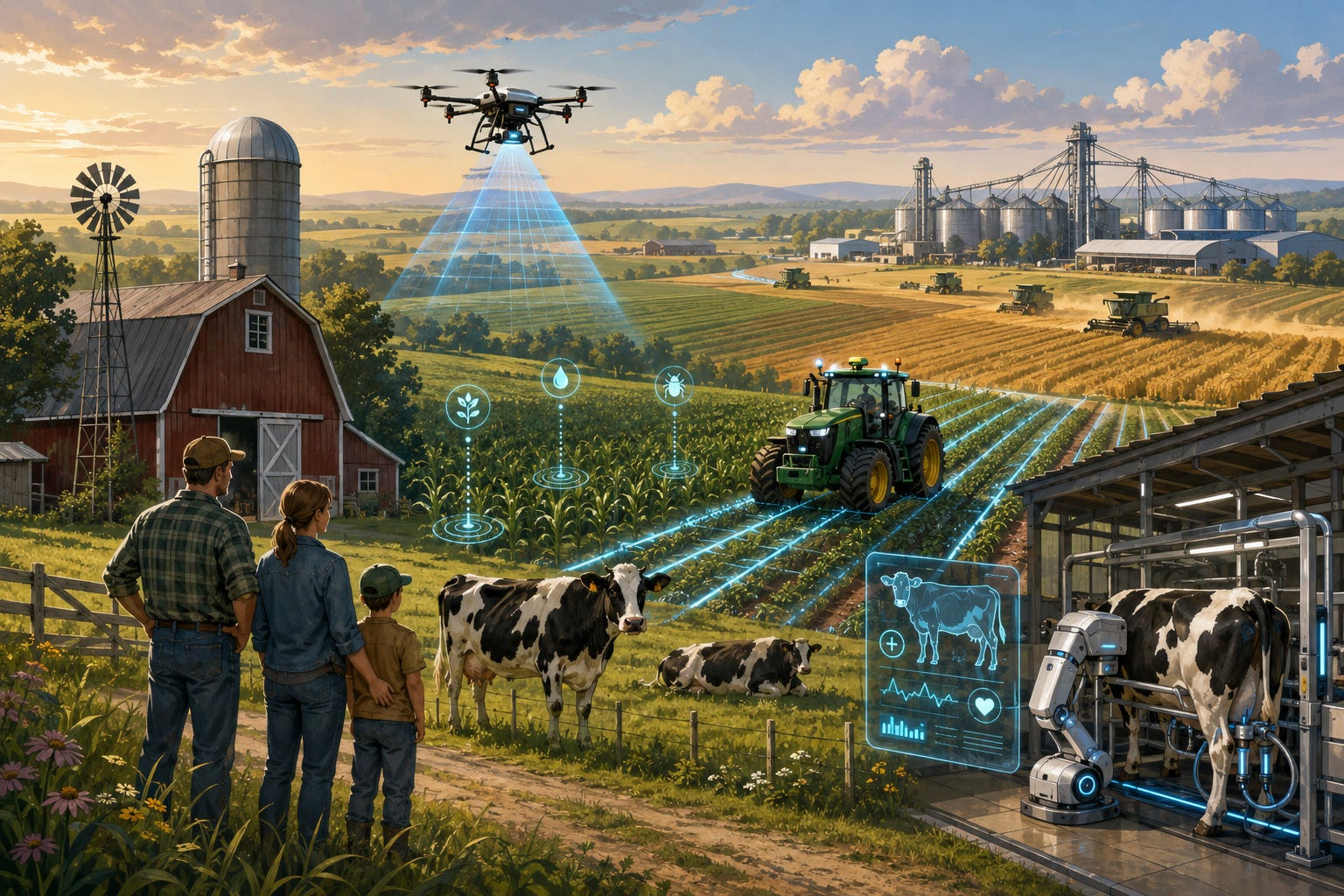
AI is powering tractor equipment for better precision; it’s helping drones inspect fields, spotting weeds or areas of poor growth; it’s analyzing data from robotic milking systems and making adjustments as it sees anomalies like a cow with readings that might indicate disease or some other malady.
In other words, the technology is embedded in expensive farm equipment. And that favors large farms who can better afford the capital expenditures, Reisinger argues.
Reisinger argues that as technology scales and better helps larger farms who can afford the investment needed to obtain this technology, it will accelerate the decline of the smaller farmer.
“If we set [AI] loose on only making farms get bigger for scale, like we’ve been doing for the last century, AI is going to speed that up,” Reisinger says.
The local picture
According to UW-Extension educator Heather Schlesser, farmers around Marathon County are already using AI tools. Many of those mentioned above, such as wearable sensors for animals with data analyzed by AI and AI-powered drones for field scouting and pesticide applications, are being used around farms in Marathon County too.
Schlesser understood Reisinger’s concerns, but says a lot of it is scalable. A smaller farmer can buy the technology for one pen of animals, for instance, and if they get a real return on their investment, they can then expand that in future years. “That is the great thing about AI: the technology is scalable. You can buy what you need.”
But other AI products such as robotic milking systems might remain outside the reach of smaller farmers, just because they are so expensive.
And as one might predict, Schlesser explained that younger farmers are more prone to using AI systems than older farmers.
A challenge the UW-Extension has been trying to assist with is data overload. With so many systems sending back data to farmers, the amount of information can get overwhelming. “A farm could be getting data from 5-6 or more different sources that don’t talk to one another.”
The simple solution
I was surprised to learn that most AI used in farming shows up in ready-to-purchase products. In other worlds I cover, AI systems ranging from Claude and OpenAI chat windows, to Claude Cowork or OpenAI’s Codex, to agentic systems such as OpenClaw and Hermes Agent, are being used in unique and interesting ways by solo entrepreneurs and small teams. They’re being used to build apps, marketing campaigns, SEO optimization. I even heard from an entrepreneur in a mastermind who was running his entire life on OpenClaw.
As Schlesser put it, most of these systems are designed to increase efficiency, opening up time for farmers to increase their output and do more with less.
While Reisinger and Schlesser mostly focused on the industry level, neither mentioned much about just using an inexpensive ChatGPT subscription, for instance.
This week, I will be reaching out to farmers to learn more about how they’re using AI. I’d like to visit a farm or two and see the operations in real life.
Assuming that pans out, you’ll see another installment in this series.
Thanks for reading The Wausonian! If you haven’t subscribed yet, check out the free and paid options below to help support local journalism covering Wausau news:
I work in IT and have used both GitHub Copilot and ChatGPT, so I found this article really interesting. I can see AI helping farmers in even more ways than what was mentioned, especially with things like feeding animals, managing spending, and budgeting. Before reading this article, I assumed AI probably wouldn’t have much of a role on smaller farms. It’s encouraging to see that isn’t always the case and that even small farming operations can benefit from AI.
I do understand some of the skepticism around using AI, and I share some of it myself. I always review and verify what AI gives me rather than simply accepting it as correct. That said, when it’s used properly, the productivity boost can be enormous.