


A municipality reached out to county leaders last year because there seemed to be a lot of calls to the Central Wisconsin Airport.
The suggestion at the time: station a deputy at the airport full-time to deal with all those calls.
After all, the data doesn’t lie, right?
But anyone who has worked with data for a while knows that the data isn’t always the full story. Sometimes there is more going on beneath the surface.
The Wausonian’s recent crime data story, looking at several aspects of crime data, is a great example. While the raw data shows lowering numbers across the board, indicating crime is decreasing, there are actually a lot of reasons the numbers are dropping, as our investigation found.
It turns out Michal Schultz, the county’s new data officer, had the same feeling about the number of CWA calls. As The Wausonian reported at the time, after Schultz investigated, it turned out the vast majority of those calls were alarm checks and other benign calls in which law enforcement doesn’t need to respond to. That prevented a costly decision to deploy an officer to the airport, instead of putting that officer to better use.
Recently, Marathon County deployed a new open data portal, a project percolating since before COVID, which of course derailed many plans. Hiring the data officer was the first step. The open data portal, where people can access county-level data from departments to census data and beyond, was the ultimate goal.
County leaders believe that the new portal makes Marathon County the first in the state to do something like that at this scale. And one of the first counties to have its own data officer.
Many might be surprised to learn that the idea originated in a county in Maryland.
Digging into the data
When Schultz took on the challenge of creating a data portal, she looked at several options for dashboards the county could use. They were expensive — some of them as high as $40,000 per year for the base packages along with other expenses.
“I thought it might be in poor taste if I was like ‘um, hey county board, I’m new, can I have a quarter of a million dollars to start something? I don’t know what it will look like yet,’” Schultz says.
But it turned out, the county already had a data portal - Marathon County Pulse. The platform already housed some information including the updates from the Youth Risk Behavior Survey.
But log on to Marathon County Pulse today and you’ll see quite a bit more. The site is a treasure trove of data in five areas: administrative and internal services, education and economic development, human services, justice system and public safety, and public works. Those five contain all the county’s departments.
For instance, under the public safety header is a data point from the Marathon County Clerk of Courts office. It shows the amounts of debt collected by the office from 2017 to 2024.
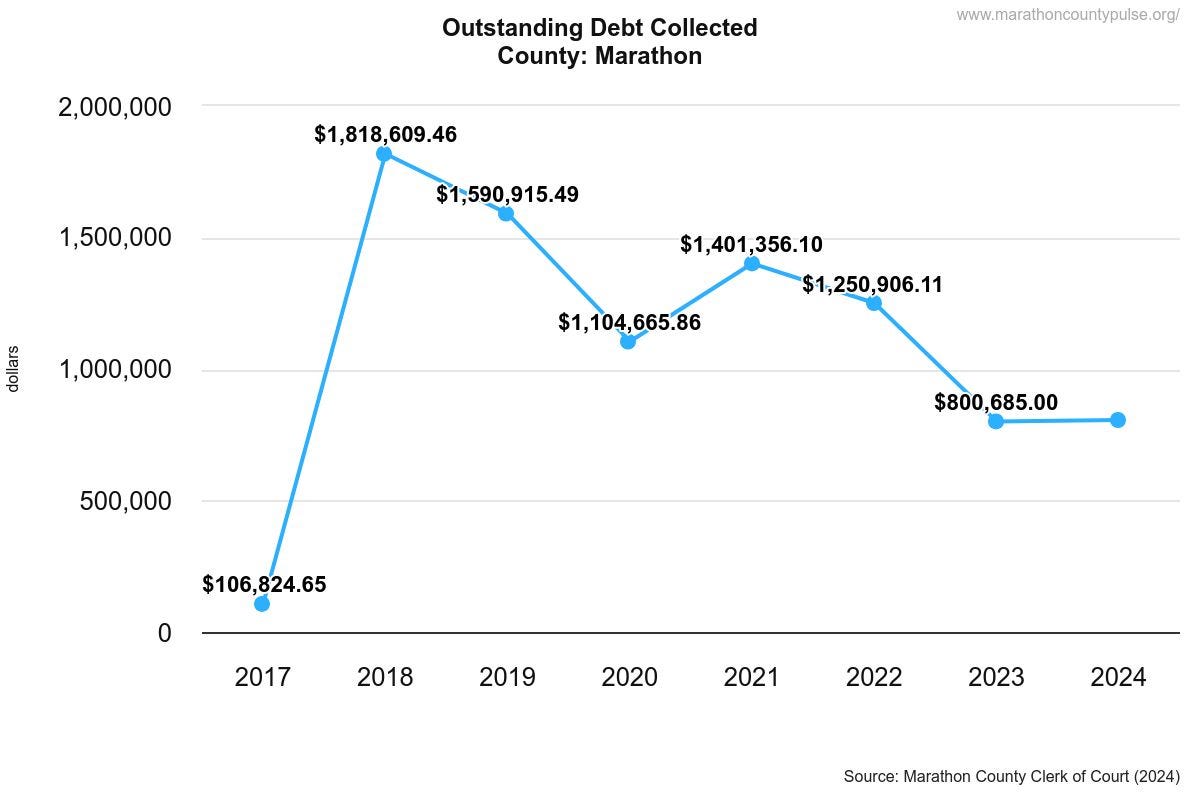
Clicking on the title on the Pulse page gives a user more information about the data being visualized. For example, it explains that this is the total of debt collected by the office, including fines, forfeitures, court costs, fees and restitution payments.
Another example: Total death investigations under the medical examiner’s office:
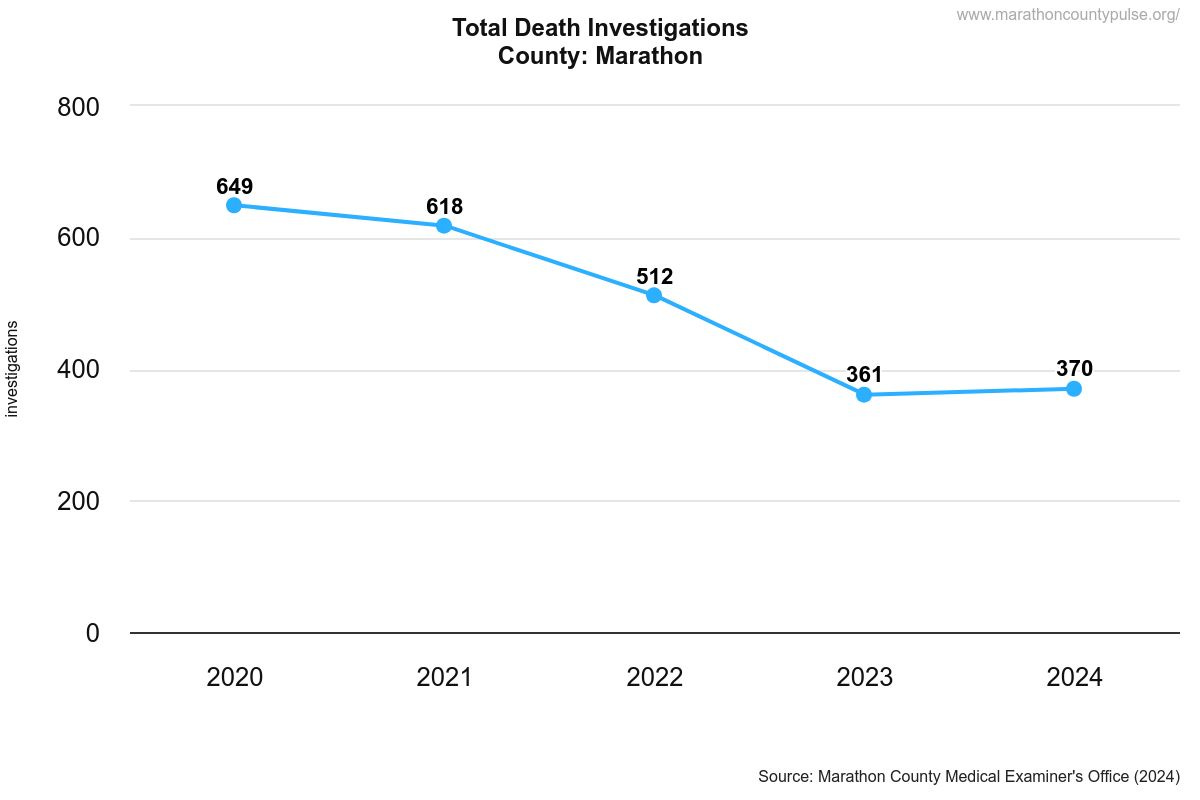
Besides being downloadable in several formats, the raw data can be downloaded in csv file for those who want to do their own data analysis.
The idea was to build a data culture. Schultz says initially there was some skepticism from some that maybe she was there to get them in trouble. But eventually Schultz was able to convince them of her role — that of neutral data steward.
Marathon County Administrator Lance Leonhard says that feelings changed when Schultz’s help started leading to savings or improved outcomes. “Now they’re like ‘Hey, that was helpful; can we take Michal and have her work on some other stuff?’”
Part of that was standardization. Schultz said they had to train everyone to enter their data in a uniform way in order to make sure the data was consistent. A lot of what helped was to find ways to automate and streamline processes so they were less of a burden on staff, Schultz told The Wausonian.
“It was a team effort for sure,” Schulz says.
Marathon County Sheriff Chad Billeb said the data officer has been instrumental in evaluating their resources and deploying them in more helpful ways. Besides the airport calls anecdote mentioned earlier, Billeb says Schultz helped them analyze data related to the Sheriff’s Office’s contract with Rib Mountain.
Billeb wrote:
As an example, Michal can show us, the peak times of the day, days of the week and the types of calls that are most prevalent in the Village of Rib Mountain. This data helps to ensure that we staff at appropriate times and to the best of our ability, adjust to the needs of the Village, when necessary.
Billeb told The Wausonian he is also supportive of the public portal. He says the public can get a sense of the volume of work being done by county workers and see the trends associated with that work.
Marathon County Veteran Service Officer Aaron Galindo said the county’s data initiative is exciting. The office had already been focusing on data, but Galindo told The Wausonian that now the public can see that data, helping tell the story of the work his office does.
Building a data culture

Leonhard says this is only the first phase. Leonhard sees the county eventually having a real-time, comprehensive performance tracking for all 24 county departments.
The county administrator said the idea came from Montgomery County, Maryland, which has published public data to its website for some time. The idea initially came about in January 2020, but COVID brought other plans and focuses.
But with the new data officer hired at the end of 2023, the plan is not only moving forward full steam, but they actually provide more information beyond just the data. Whereas Montgomery County provides the data, Marathon County on its Pulse site provides much more.
Leonhard tells The Wausonian that county leaders have identified 281 key performance indicators that the county wants to track in real time, to evaluate how its departments are improving and where improvements could be made.
But in the meantime, the public will have a much better sense of what goes on in the county and the trends impacting both county staff and the community.
“It’s the power of visualizing data,” Schulz told The Wausonian. “It really does help.”
Correction: A quote from a source in the story previously misspelled Schultz’s first name. It has been corrected.
Thanks for reading The Wausonian! If you haven’t subscribed yet, check out the free and paid options below to help support local journalism: