

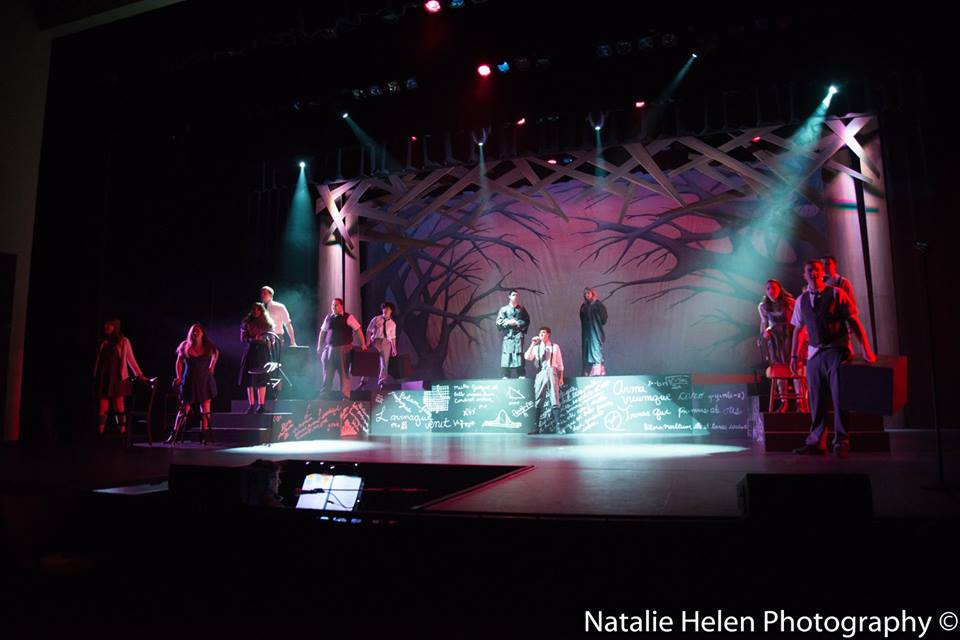
The following is a guest column by Sarah Rudolph, who taught theatre at UW-Marathon and later UWSP-Wausau for many years. Guest columns don’t necessarily reflect the views of the publication, and the opinions are those of the author.
Whether calling it a high school with ashtrays, “the stench,” Extension Campus, UWMC or UWSP at Wausau, you likely knew the small campus on Stewart Avenue as a vital community hub for sixty years.
At the end of May, however, the doors to those campus buildings will close, reopening under the jurisdiction of Marathon County. In the meantime, members of the County Board will review proposals for occupying those spaces. UWSP at Wausau will maintain a presence at Northcentral Technical College. A reception and open house on May 12 will mark the closure of these buildings, beginning with a program in the Veninga Theatre at 625 Stewart Avenue.
For six decades, this campus provided students with an outstanding way to begin their higher education. Indeed, students who began at UWMC and transferred (as many did) to UW-Madison graduated at the same rate as those who began at that selective flagship university.
Perhaps rather than college credit-bearing enrollment, you enjoyed the rich multigenerational opportunities offered through Continuing Education: College for Kids in the summer and Good Ideas for Seniors every January. Our lecture series offered fare across diverse interests. Campus gallery exhibits and live performances invigorated Wausau’s already robust arts scene. The annual Our EATS (Educational Assistance Through Scholarships) fundraiser provided generous support for students while becoming a popular tradition featuring fine food, drink, entertainment and lively interaction.
Before moving to Wausau in 1991 for a one-year position as an instructor, my acquaintance with and esteem for two-year college programs were quite negligible. In rare coordinated choreography, my UW-Madison theatre professors looked down their noses when I took the position, while my classmates consoled me: “Well, it is only for a year.”
In retrospect, however, most prescient was an interaction I had with another department alum who taught high school. A smile beaming from her face, she called the UW Colleges one of Wisconsin’s very best ideas.
The substance of her observation gradually came to light. With a fresh PhD, two very young children and a (fortunately very capable theatre) spouse in tow, I arrived in Wausau. A year became three decades.
Running a small, grassroots theatre program demanded an all-but-impossible workload and indeed would have proved so without the able assistance of my husband, Brad Schmicker, and technical directors Dave Dickinson (RIP) and the now-legendary Kris Berge (initially paid with proceeds — if not the actual coins — from campus vending machines). However, the freedom to produce theatre fitting with my sensibilities offset that burden.
Working with community members in crews and cast alike enriched my life immeasurably, as did all the students who graced our productions — ranging from the unsuspecting speech student from a rural outpost whom I drew in as a spear-holder to students who would elevate any theatre program.
Incredible colleagues whose first priority was teaching further substantiated how good an idea Wisconsin had with the two-year campuses. Unlike the separation from other disciplines that might define one’s career at a large campus, faculty across the curriculum interacted on a daily basis.
Together we met the needs of a wide spectrum of students, from those with considerable academic deficits to others with perfect high school GPAs and high test scores. While teaching took top priority, many faculty members — particularly those on the Marathon Campus — sustained productive scholarship, publishing books, spearheading academic conferences and contributing to highly respected journals.
The campus support of professional development opened many doors to me, including participation in an international effort exploring the representation of mental illness in performance.
A true sense of community existed on our campuses. Of course, we competed for merit, which sometimes meant pay raises, and we could, of course, butt heads as high-spirited people. But overall, the atmosphere was warm and collegial, with the kind of affectionate, often satirical banter I enjoyed with my Colleges’ colleagues.
Perhaps only that sustained us through the obstacles to which our campuses were particularly vulnerable as pressures mounted. We faced budget shortfalls, enrollment challenges and often baffling directives from on high.
In 2018, however, came the decree that we could not survive. University administration and the Board of Regents dissolved the UW Colleges, attaching our campuses to nearby comprehensive institutions, including Stevens Point. These campuses had no more say and, as I recall, even less notice of the restructuring, finding themselves in something akin to shotgun weddings.
Some receiving campuses were better positioned to respond with innovation than others. Stevens Point will offer UW credit courses in Wausau through Northcentral Technical College, and its Marshfield campus remains open. UW-Milwaukee, UW-Platteville and UW-Oshkosh have all closed their two-year campuses.
Of course, this bad idea did not rest solely with University of Wisconsin leadership. Online college enrollment soared while high school class sizes declined, and finally, COVID created a point of no return.
In 2005, I played Linda Loman in the Wausau Community Theatre’s production of Arthur Miller’s Death of a Salesman. As both a theatre artist and scholar, I relished her lines as, at once, pronouncements about the best uses of theatre and language, underscoring the essential American ideal that all are created equal.
Linda insists that “attention, attention must finally be paid” to characters like Willy Loman — an unextraordinary and flawed person unable to hold on in a rapidly changing structure. When Willy laments a future in which neither of his sons will live in their home once they pass, Linda reminds him that “life is a casting off … it always has been.”
Theatre encapsulates and articulates truth most poignantly. The UW Colleges paid quality attention to those other institutions might overlook, which makes this “casting off” a particularly devastating one.
Sarah J. Rudolph
Professor Emerita