

In what is becoming a recurring theme, city leaders are mulling exactly how to overcome a $1.05 million budget shortfall for next year.
City leaders already made a series of cuts in the 2026 budget to help keep spending in check — and voters approved a levy limit increase of $1.45 million to fund the salaries of firefighters originally hired under a grant program.
But now the city is facing another budget gap.
The Wausonian obtained a slide presentation made for city officials that was not released publicly showing some of those ideas. And here are some of the ideas being floated around to combat the coming shortfall.
It should be noted that the numbers are preliminary. Writing city budgets is usually a challenging proposition — the process starts when many variables are unknown, and so assumptions need to be made. (Insurance premiums and shared revenue amounts are two good examples.)
It’s also worth noting that the presentation came from the asking of City Council Members Carol Lukens and Sarah Watson. Their April letter asked for budget information earlier in the process than it is typically received.
So here is a breakdown of the problems and current proposed solutions.
The problem
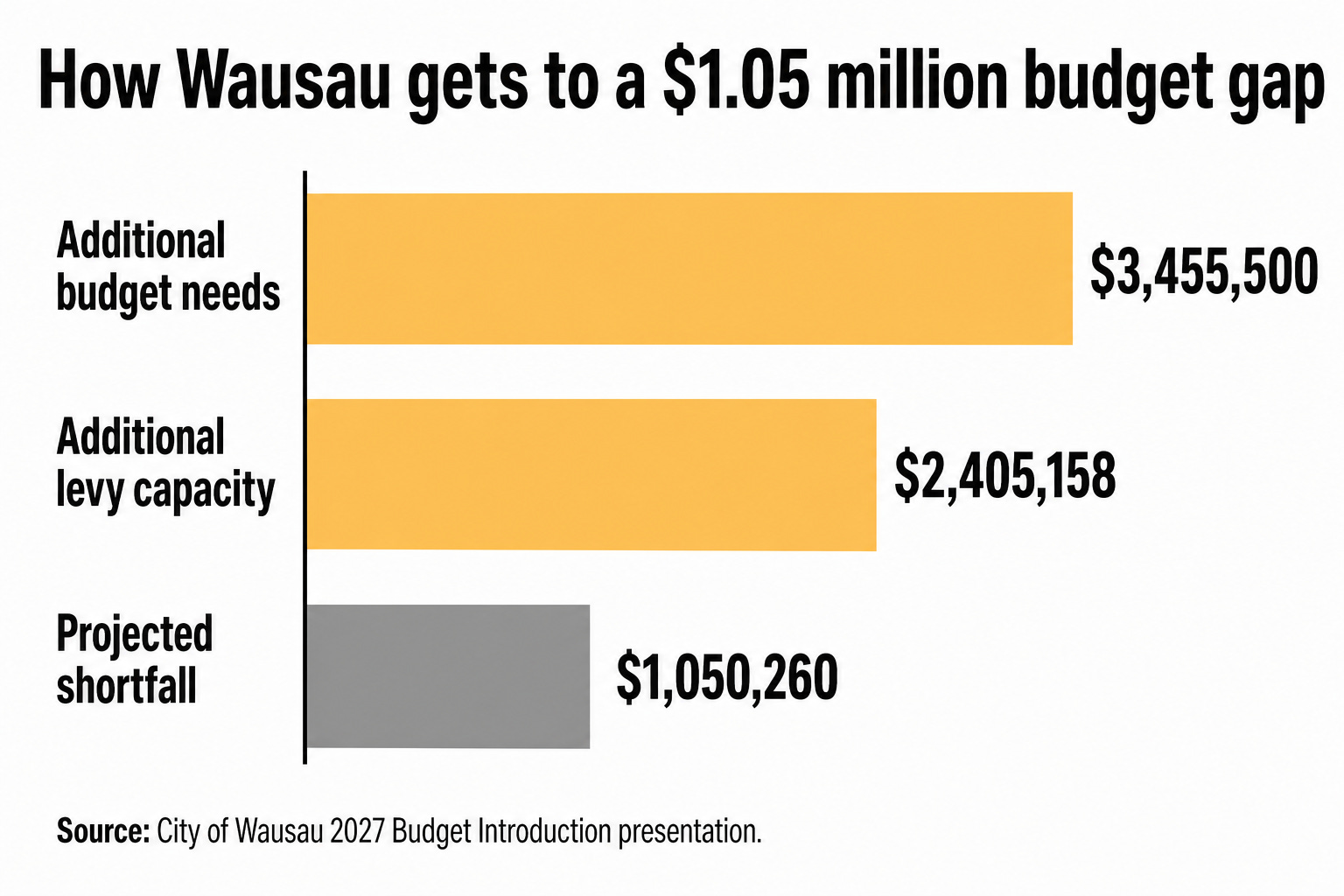
The $1.05 million budget gap comes from an increase in spending next year of $3.46 million, and an increase of only $2.41 million in new levy capacity to offset it.
The increase in costs is largely driven by personnel expenses — the city expects its wages and benefits to cost $1.7 million more than this year. A big part of that is a 10% increase in annual health insurance premiums. Also driving those increases are changes to the Wisconsin Retirement System, cost-of-living adjustments, and filling of vacancies in the legal, police, fire, engineering and finance departments.
Also driving costs higher are a $300,000 increase in the Harter’s garbage and recycling contract, a $615,000 increase in general operating expenses, $388,000 in additional debt costs and a $300,000 increase in the transit subsidy.
The report that MaryAnne Groat delivered to the city’s Committee of the Whole also includes a $1.5 million motor pool deficiency, but that’s not included in the $3.46 million increase. In fact, the breakdown amounts don’t add up to the $3.46 million — they actually add up to $3.3 million, so there is an extra $155,000 not accounted for.
The Wausonian reached out to Groat for clarification but an email auto-responder explained she was not in the office until Monday.
The solutions
The $3.46 million isn’t the budget gap, thankfully. New revenues help close it. But it does reveal a structural mismatch between new revenues and new expenses.
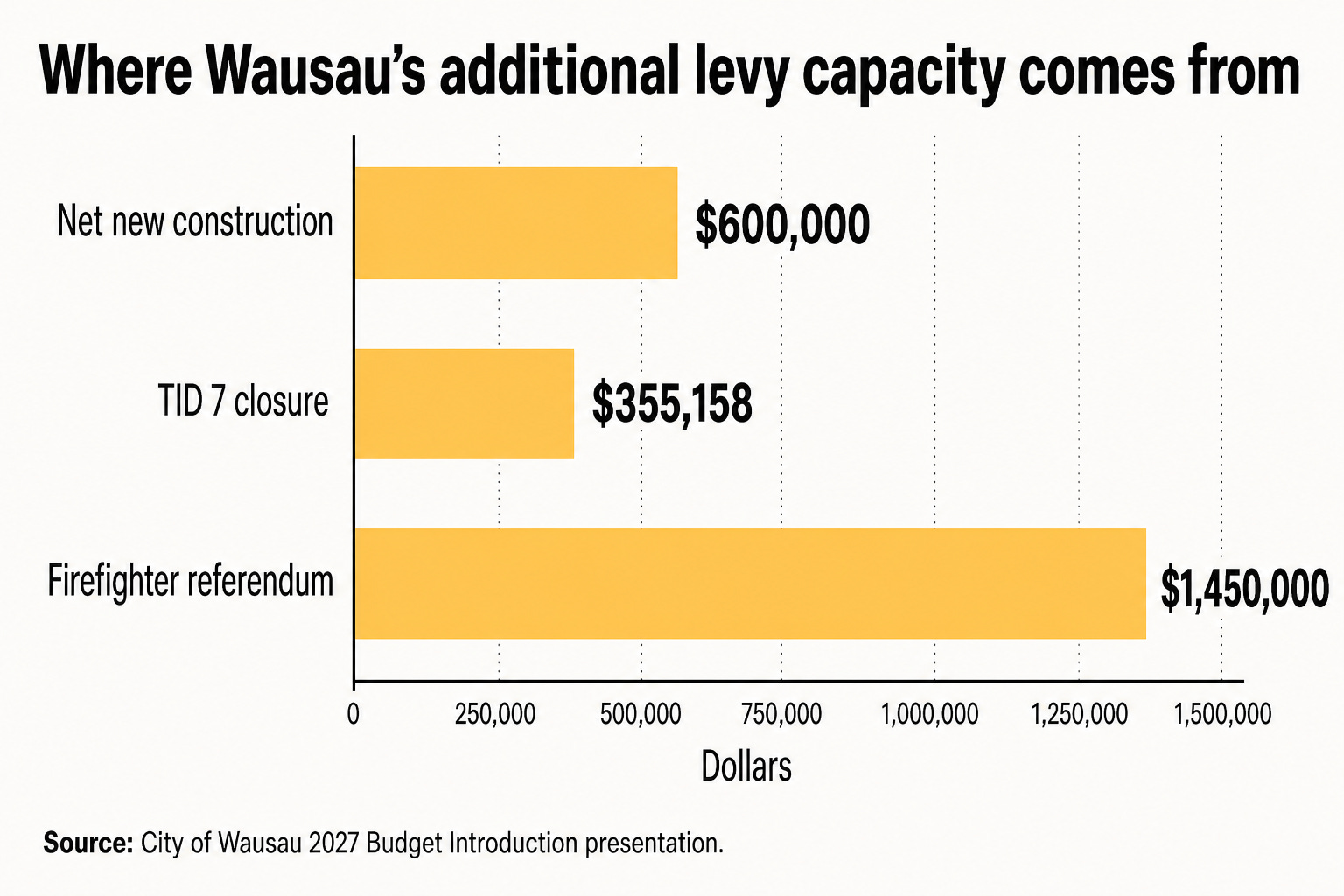
The city expects $2.4 million in new revenues. That comes from $600,000 in new levy limit capacity from net new construction; $355,000 in new tax revenue from the closure of TIF District No. 7; and $1.45 million from the referendum-approved levy limit increase.
Groat presented some solutions at that meeting — and many of them will get the attention of residents and business owners.
Vehicle registration fee: The Marathon County Board approved a wheel tax in 2016. It took effect in 2017, and became permanent after that. Technically called a vehicle registration fee, it shows up on a resident’s bill when they go to register their vehicle. (City leaders at the time tried to get a cut of the fee when it was proposed and got a hard no.)
Stormwater and/or refuse and recycling charge: One benefit of a stormwater charge is any property, whether for-profit or non-profit, would have to pay a charge based on how much impervious surface area for stormwater they have. A recycling/refuse fee would be more straightforward.
Forestry, streetlight and snow-removal fees: These ideas are less straightforward and less developed.
Intergovernmental consolidation or service transfers: The presentation also points to the state's Innovation Grant program, which can provide funding when governments consolidate services or transfer them to another government or nonprofit and achieve required savings.
The budget ahead
The presentation comes early in the process - there is a lot of work between now and November when next year’s budget is typically approved. Budgets sessions are typically held by the city’s Finance Committee, where the numbers are hashed out and decisions made.
But the early look gives council members and departments heads some time to start thinking about a potential looming deficit.
Thanks for reading The Wausonian! If you haven’t subscribed yet, check out the free and paid options below to help support local journalism covering Wausau news:
The city could also use AI to improve efficiency across many of its daily operations. If implemented effectively, AI could potentially reduce staffing needs by automating routine administrative work and improving productivity.
AI could also be used to analyze operational data from departments such as the Fire Department. For example, if data showed that a large percentage of calls are medical emergencies that primarily require EMS services, the city could evaluate whether sending a full four- or five-person fire crew to every call is the most efficient use of resources.
I suspect that if a comprehensive study were conducted on city government operations, it would show that AI is still greatly underutilized and that there are many opportunities to improve efficiency and better allocate resources.
Has anyone asked these questions yet instead of simply raising taxes on everything. Have we looked at other garbage collection services. I could go on but I have heard articles on how farmers are using AI but what about are city government which is typically administrative bound.
Thanks for this great story on the budget gap Wausau.