

Much like the conversation nationwide, Flock cameras are controversial on the Wausau City Council, and the debate isn’t breaking along partisan lines.
City Council Member Tom Neal brought up eliminating the cameras from the police department’s budget in 2027. And Matt Hoenecke agreed.
City council seats are technically nonpartisan positions. But Neal is one of four candidates who received support from a left-wing political action group last cycle. That same PAC also supported Hoenecke’s opponent, Lisa Rasmussen, in the spring election.
But both opposed the use of Flock cameras. Hoenecke cited privacy concerns and potential misuse. And council member Vicki Tierney said she wanted to see more information about the safeguards in place with the use of the cameras.
That has the potential to be a fight as the city’s 2027 budget moves from the Finance Committee to the full council for approval. Police Chief Matt Barnes cautioned that the city’s contract runs through the end of 2028, and simply removing the funding might not eliminate its payment obligations.
As we did with Marathon County last week, in this post we will break down everything we know so far about Wausau’s budget for 2027.
What we know so far about the 2027 Wausau budget
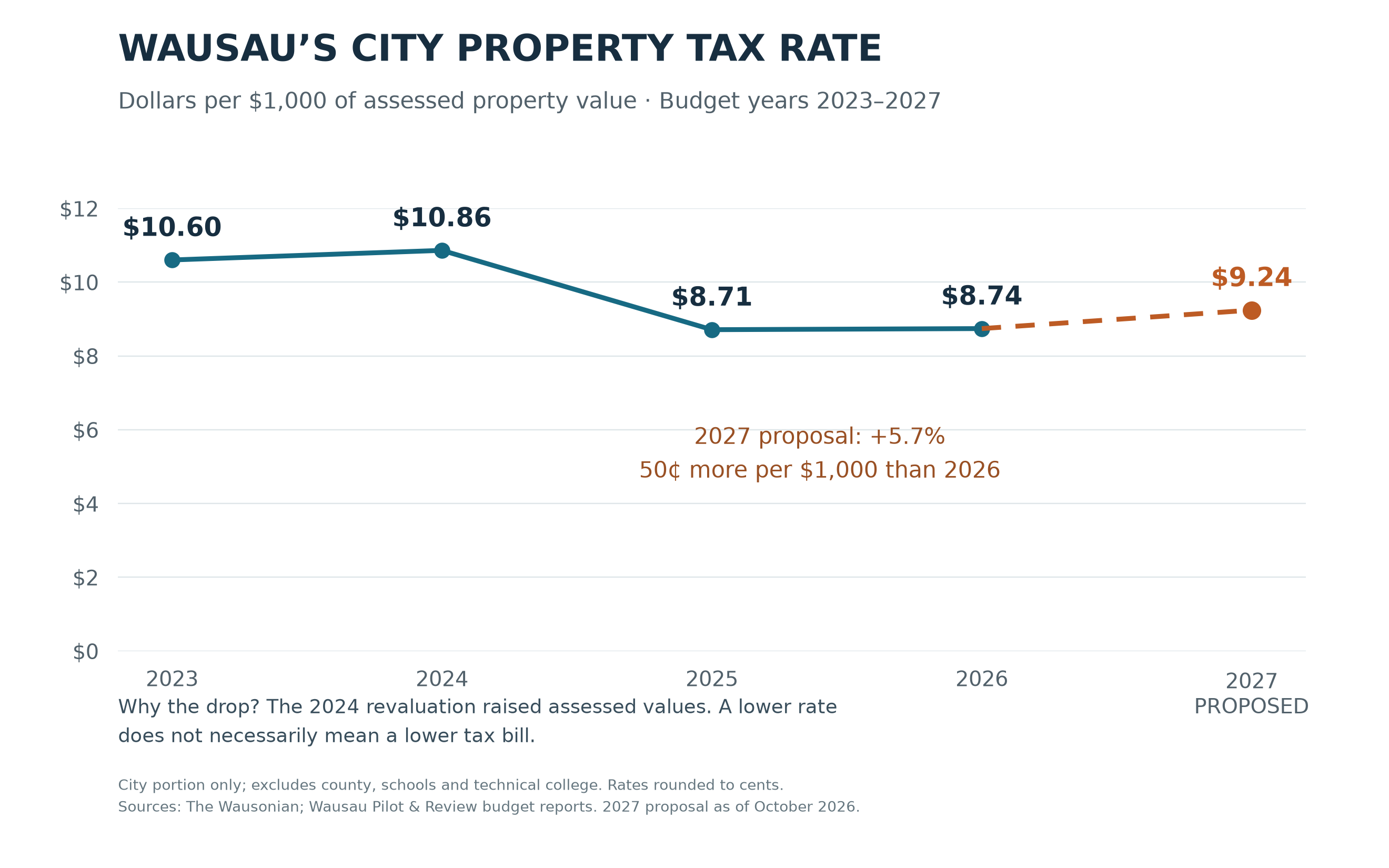
Good news/bad news: The good news is that city expenditures are projected to decrease next year, from $171.33 million this year to $158.43 million, a drop of 7.53%. The bad news? The actual levy increases from $38.06 million to $40.63 million, and the tax rate is expected to climb from $8.84 to $9.24 per $1,000. That amounts to about $80 more on a property whose assessed value stays at $200,000, or roughly $100 if its assessed value also increases 1%, as assumed in the city’s example. About half the levy increase (56%) is from the referendum allowing for additional spending on firefighters.
Employee costs are adding up: The city for next year is including a 3% cost-of-living raise for nonunion employees and 4% for public safety and transit employees, according to the budget presentation. Insurance costs increased 9.6% for next year. One thing that’s helping: The city is saving about $410,000 from managed vacancies on top of the $300,000 already built in to account for vacant positions.
Police budget increases: Despite operating with 80 officers instead of 81, the police department’s spending is expected to grow $307,445 next year, a 2.12% increase. That’s despite the police department cutting its community service officer program in half, saving $45,000. And it will save another $45,000 by bringing the crossing guard program back in-house, which it did earlier this year. Not immediately filling vacancies from retirements could also alleviate some of those costs. Another measure Barnes is hoping to accomplish in the next school resource officer agreement: Get the Wausau School District to cover the full school-year cost of the officers — right now it pays 75% of that cost, with the city also covering the summer months.
Fire department spending goes up more: Spending for the FD will rise $720,313 next year, a 6.31% increase. The department hasn’t filled an operations division chief position, has another retirement coming that would allow a position to remain vacant temporarily, and has six firefighter positions currently sitting empty. The department is working to fill those firefighter vacancies. It also proposed cutting down on conferences and travel, and using a robotic mower instead of spending $10,000 on contracted mowing.
Want more budget news? See our coverage of the County’s proposed budget:
Everything you need to know about Marathon County’s 2027 budget

Marathon County has always had one of the better budget processes of local governments I’ve covered.
An administrator position is included in the budget: The city held a town hall about the potential of Wausau having an administrator — and the budget includes $150,000 in case that’s something the city decides to do. Mayor Doug Diny said the position would still need approval, with a possible start around May or June. The allocation shouldn’t be read as a proposed annual salary. Not everyone was on board with the idea of budgeting for it before the city underwent an organizational audit. On Wednesday, Hoenecke proposed removing the $150,000 as part of a broader general-fund spending reduction. The committee did not approve that change that night.
Another position?: There was also concern about a $100,000 allocation for a new HR position. Council member Sarah Watson questioned that, saying the position had already been rejected and would need to go through the approval process again.
Parks proposes small cuts: The city’s parks department is proposing some cuts as costs increase a little less than $42,000. The department’s proposed budget includes keeping two pools open each weekday and all three on weekends, with pools rotating their closures during the week. No downtown hanging flower baskets in the operating budget, though the committee could again choose to fund them with room tax money. Only five docks at the wharf instead of seven, along with reduced seasonal staffing. But the small park projects budget would increase from $81,000 to $105,000, allowing the department to tackle more deferred maintenance projects.
The $1 special event fee didn’t bring in enough to cover expenses: In last year’s budget, the city implemented a $1-per-ticket fee to recover some costs from city workers, including police and public works. Groat reported $33,278 in collections, with collection work still underway, but council members questioned whether that was enough to cover the costs associated with helping at the events. No increase to the $1 ticket fee was proposed at the meeting.
A new pet fee?: Watson proposed a $25 license fee for spayed or neutered dogs and cats, with a $10 discount for microchipped pets. Her proposal was a lower-fee alternative to the proposed $30 rate, with remaining shortfalls covered by the animal control fund’s reserves while the city takes another year to study its funding model. The proposed budget already anticipates using $24,854 from that fund’s reserves for 2027.
Wednesday’s meeting added a lot
I expected Wednesday’s meeting to mostly be about discussing what was already on the table, but many new proposals came to the floor Wednesday evening.
Finance Director Maryanne Groat suggested the city move $2.18 million in road projects to TIF funding. That would include reconstructing South 11th Avenue, design work for 17th Avenue and $300,000 for asphalt overlays. Groat estimated that could shift roughly $275,000 in annual debt payments off the general levy, though it would require an amendment to TID 8’s project plan.
She also suggested gradually phasing out borrowing for recurring street improvements, putting them on the levy instead. (Which reduces interest costs associated with borrowing the funds.) Her suggestion was to add $130,000 annually, with an inflation adjustment, to move roughly $1.3 million in recurring improvements to cash funding over ten years.
Groat also proposed moving some special revenue funds into the general fund to take advantage of more than $300,000 in room under the city’s expenditure-restraint limit. That would build up the base used to calculate allowable spending growth in future years, rather than create new levy capacity.
City council member Matt Hoenecke proposed capping borrowing at $17 million–$18 million, deferring roughly $4.2 million–$5.2 million in projects and shaving 1% off general-fund spending, about $500,000. Hoenecke said the goal was to reduce outstanding debt by $1 million or at least hold it steady. He sought more information on legal requirements, immediate safety needs and whether deferral would substantially increase costs. Hoenecke specifically asked about delaying Ethel Street reconstruction until 2028. Public works staff cautioned that deferring projects would push back other streets in the schedule and increase maintenance needs.
Other projects that came up included spending $700,000 for repairs to the former Sears parking ramp; replacement of the air conditioning in the Jefferson Street ramp; $150,000 for downtown/Forest Street preliminary engineering for a future road project; just over $600,000 for MBX South demolition and associated work, with a possible $250,000 WEDC grant; and some site preparation and marketing work at the business campus.
Groat also flagged a future budget pressure: Environmental-cleanup reserves are shrinking now that insurance-annuity payments have ended. Eventually, she said, those costs will need levy support.
As of press time, the city’s Finance Committee has not yet approved the budget, and it postponed Thursday’s planned budget meeting to allow more time to prepare amendments and gather more information. And nothing is final until the Finance Committee and then the City Council approved the final version.
But this is where the 2027 Wausau budget currently stands.
Thanks for reading The Wausonian! If you haven’t subscribed yet, check out the free and paid options below to help support local journalism covering Wausau news: