

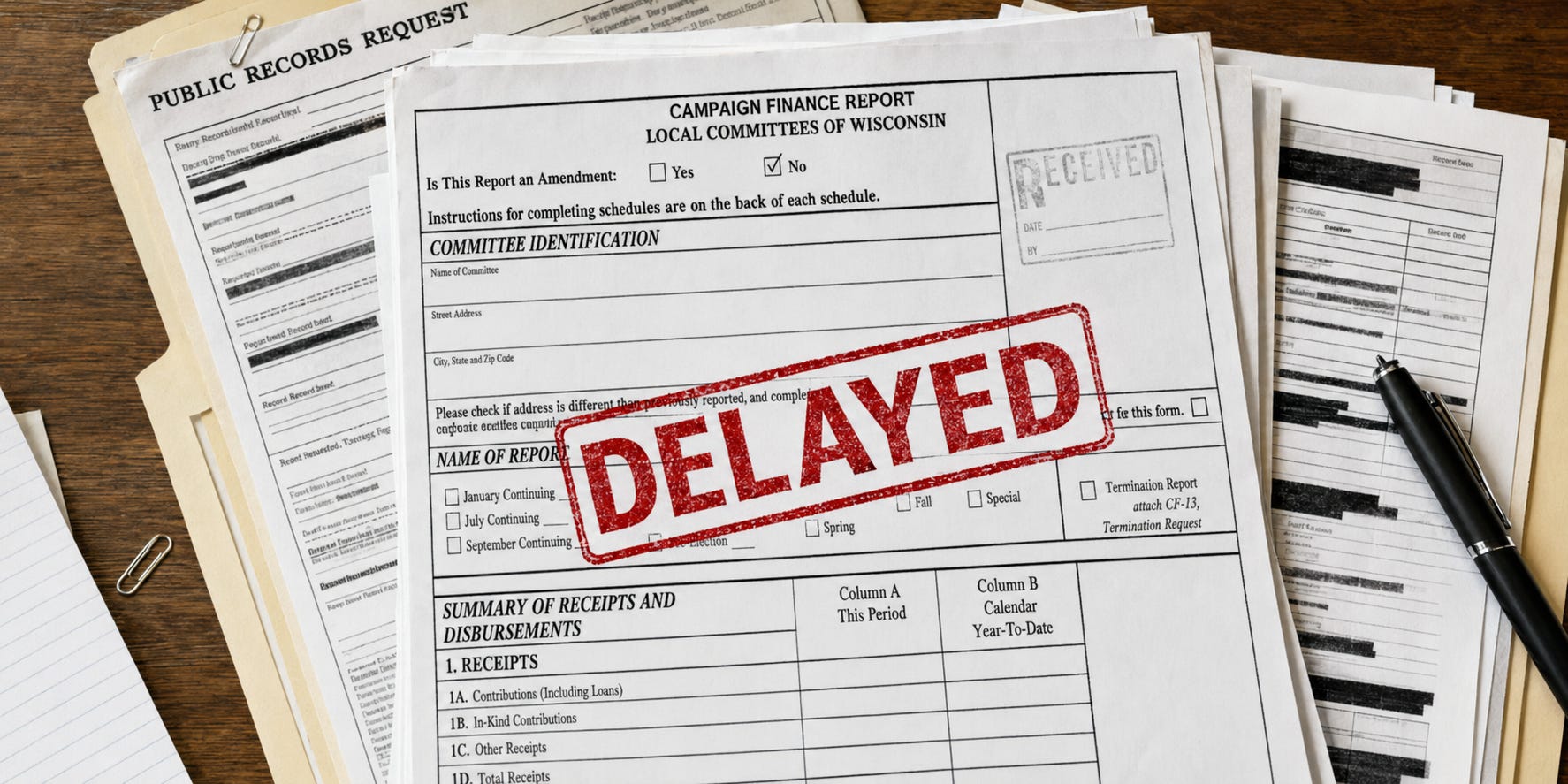
In February, The Wausonian reached out to various clerks with a pretty standard request: Campaign finance reports for the pre-primary filing period.
They’re standard requests that any journalist would make around election time.
I received quick responses from the Wausau School District Clerk and the Marathon County Clerk.
My request to the Wausau City Clerk went unanswered.
I sent a follow-up email to then-City Clerk Kaitlyn Bernarde. It was met with silence.
The next period is the pre-election campaign finance filing period. I again requested reports for all three entities.
The school district and county clerks returned the filings in less than 24 hours. The records are usually turned around quickly since they’re public records that the candidates are filing out themselves (or campaign staff, if they have them). There aren’t typically any redactions needed that could slow the process.
Again, nothing from the city clerk.
I’d started talking to attorneys, since this was almost certainly a violation of the state’s open records law. But since Bernarde had already resigned, The Wausonian decided it would be best to hold off and work with the new clerk.
I met with new Wausau City Clerk Rachel Brown after she started in early June. She was diplomatic but took notes on the situation and said she would see what she could do about getting me the records.
I met with Brown Monday, June 1. By Friday, June 5, I had the records for both the pre-primary and the pre-election.
Four days versus four months.
What the records showed
I only received two sets of records for city council candidates. Both were from candidates who didn’t win in April: Keene Winters and Vylius Leskys.
According to the latest campaign finance filings, Winters took in $4,959 to date as of the pre-election filing. And he’d spent $3,795.
Winters’ top donors in the period were himself ($2,128), Ruth Schuette ($500), and Gerald Whitburn ($400).
And according to Leskys’ filings, he took in $850 year to date as of the pre-election filing.
Leskys’ campaign was completely self-funded, at least year-to-date.
The only other filing came from the Firefighters for a Safer Wausau Committee. That committee took in $15,024 and had only spent $4,984 as of the pre-election period. Mark Koepke signed the committee’s filings.
Where the bulk of that money came from is where things get interesting. The full amount came from two sources: The Wausau Firefighters Local 415 donated $10,023, according to the filings. And the remaining $5,000 came from the Professional Firefighters of Wisconsin, which lists its address as Madison.
That doesn’t mean that other money wasn’t spent on this election. Candidates do not need to file campaign finance filings unless they plan to take in and spend more than $2,500, in aggregate. In other words, if a candidate spends $1,200 and takes in $1,400, that would meet the threshold because it’s the sum of the two.
And we know there was outside spending by candidates. In my neighborhood, residents received fliers about candidate and incumbent Carol Lukens from the State and Local Elections Alliance. The organization doesn’t specify party affiliation (nor does it claim to be non-partisan), but the donations button funnels to a channel run by Act Blue, a Democrat donation platform. (The Republican version is WinRed.)
According to the organization’s social media, it supported not only Lukens in District 1, but Tom Neal (4), Kristin Slonski (6) and Lisa Rasmussen (7). All but Rasmussen won in April.
The organization supported city council and mayoral candidates in other cities in Wisconsin as well. Because that spending was conducted without coordination with the candidates, under state law candidates aren’t required to report that spending on their campaign finance forms even if they benefitted from them. The organization that spent that money would.
One of the strange features of Wisconsin is that there is a deadline before the spring election, which covers up to March 23. And there isn’t another filing until the July Continuing period, which isn’t due until July 14.
It creates a strange situation in that you see spending up to about a week and a half before the election — and then you don’t find out how candidates spent money during that last push, and who supported them in it, until months after the election is final.
It also means when you have an unresponsive clerk, even the pre-election filings remain opaque until long after the last ballot is cast.
Bernarde left the city to take a job as the deputy clerk in Madison. There is no public email address listed, just a general clerk email. I reached out to that email to ask about potential causes of the delays and to give her a chance to respond to my framing of the situation.
As of publication, she hadn’t responded.
I asked Mayor Doug Diny about the lack of records response during his administration. He responded as follows:
My message would be to simply state that open records requests are a priority for Clerk Brown and me. I’ve seen improvements already since she started. I’m confident that our media friends and the public will notice. I’m also committed to professional dialogue with local media to make the process as transparent and efficient as possible.
Thanks for reading The Wausonian! If you haven’t subscribed yet, check out the free and paid options below to help support local journalism covering Wausau news:
This story is the tip of an iceberg. When Bernarde failed to secure a ballot box as required prior to the 2024 election (proven with meticulous chronological documentation of improper ballot box signage/security), Diny took the heat by doing what she should have done in the first place. (albeit in a signal fashion). Then about a year later, she is given an inaugural award by the Wisconsin Municipal Clerks Assoc.for exceptional work? Within 6 mos. she is taking the deputy city clerk position in Madison; just through the April 2026 elections. Hmmm....In the meantime, she wouldn't respond to a records request, in a reasonable amount of time, being the award winning paragon of efficiency and progress as a clerk. This adds up to too many contradicting coincidences to brush off. Have we heard the last of Kaitlyn Bernarde's "work"?