

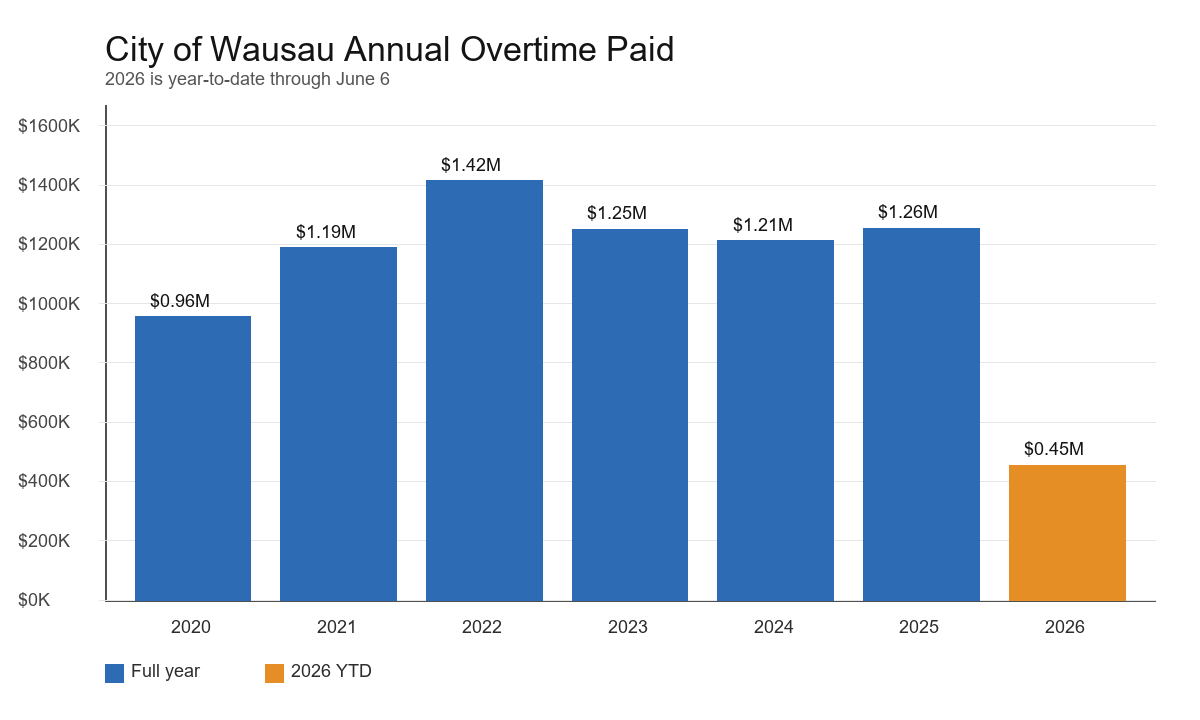
A new group is digging up data on the city of Wausau. And what those records reveal is illuminating.
One story already came out in another media outlet. It featured Fire Department overtime spending.
The Wausonian has been analyzing the spreadsheet files showing the entirety of the city’s overtime spending between 2020 and 2026 to date.
What did that reveal? The Fire Department isn’t the only department with a tremendous amount of overtime spending. In fact, though one of its employees had the most overtime payments of anyone in the city, the fire department was only the second highest in total department spending. The police, fire and public safety departments spent the most.
The staggering amount of overtime spending comes on the heels of the city struggling with tight budgets in recent years and recently convincing voters to approve raising the city’s levy limit to fund new firefighters who were previously paid for via a grant.
But worse: There appears to be a snafu in information sharing between two city departments, which should be sharing data around payroll and overtime. And that led to a challenge in tracking.
What looked like it would be a simple data story turned into something much more troubling. But first, what does the data show?
Overall spending
Three departments led the city in overtime spending between 2020 and 2026 to date. The Wausau Police Department had the most with $2.835 million in that period. The Fire Department was close behind with $2.666 million.
Third place is the Public Works Department. That total is less, at $1.344 million. But the Utilities Department added another $485,000, putting the total between the two at close to $2 million.
But from the visualization below, it’s easy to see that the two public safety departments make up much more than half of all over time spending.
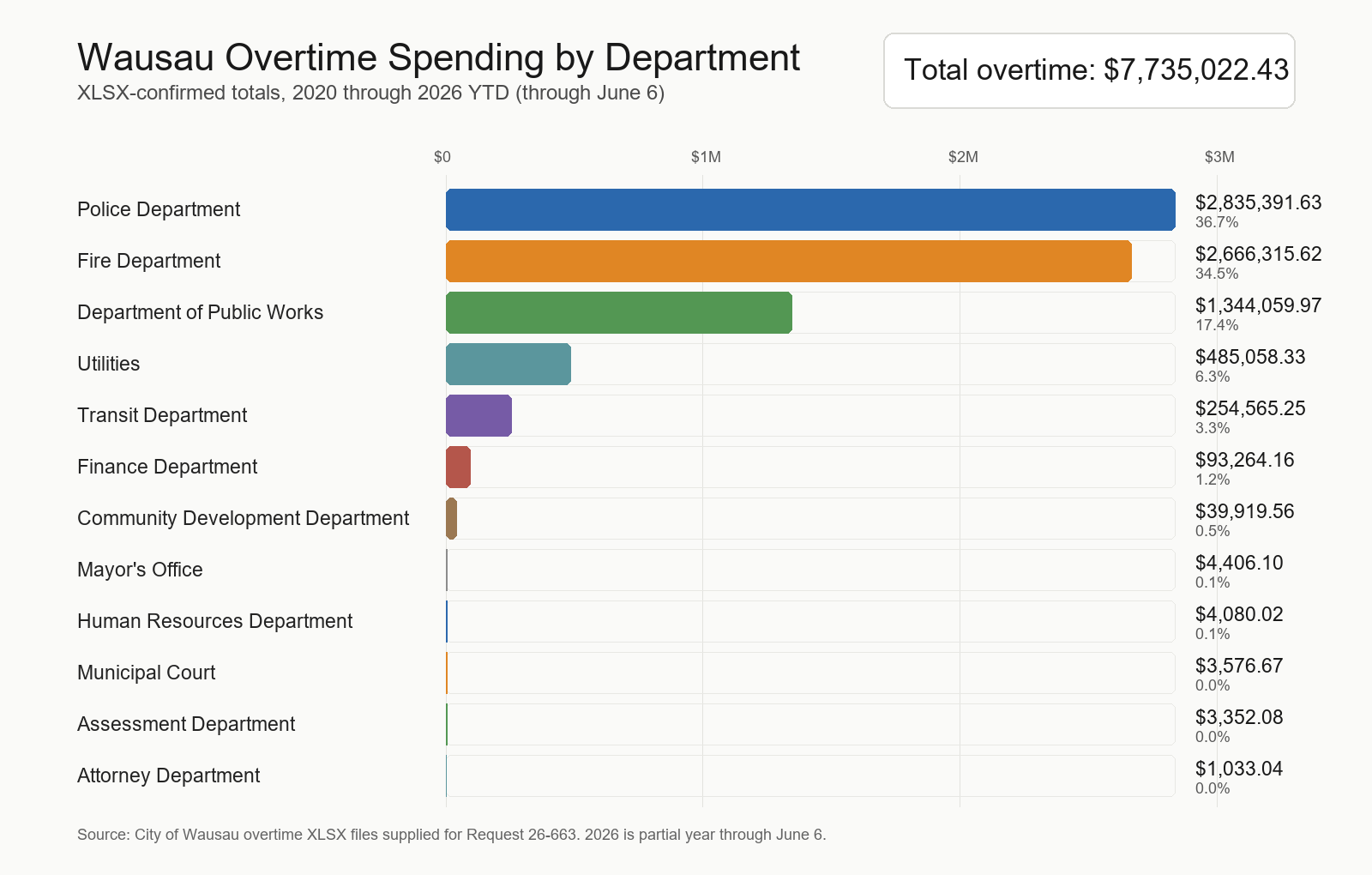
So it makes sense to look at the yearly spend of those two departments.
The Police Department
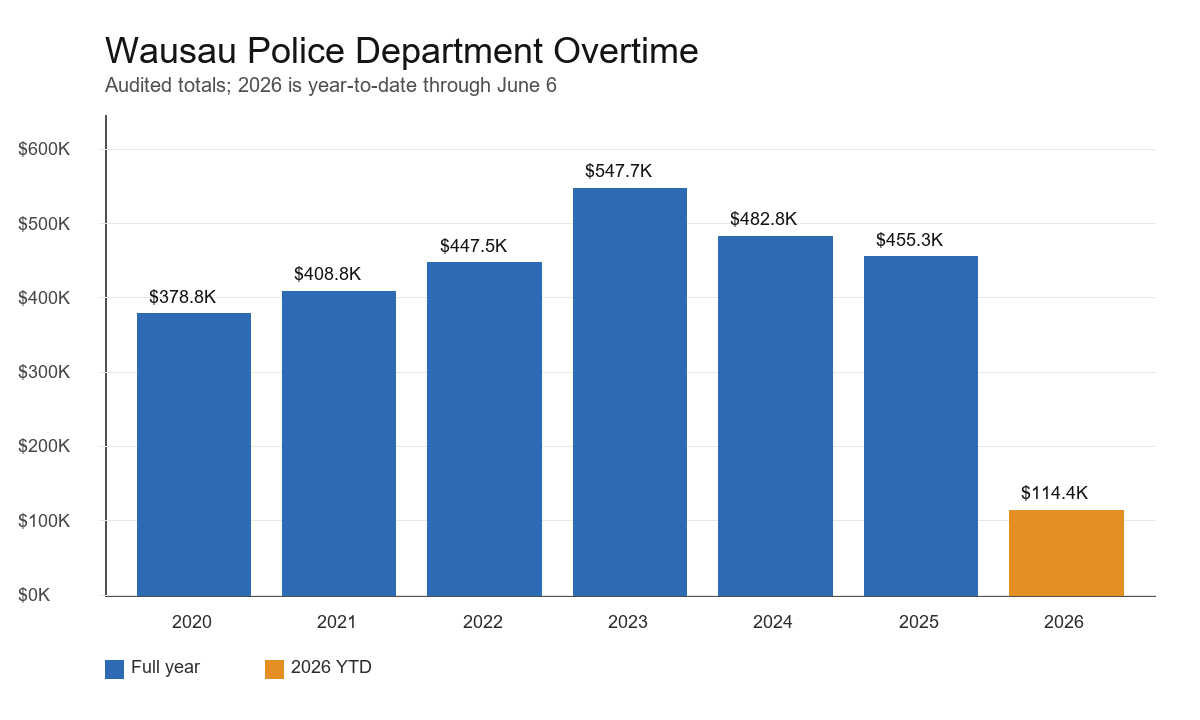
Nearly halfway through the year, it might appear that the Wausau Police Department has dramatically cut down its overtime spending.
That spending has been on the decline since its peak in 2023, but this year represents a substantial change in the amount of overtime.
Why the rise from 2020 to 2023? And why did it decline in subsequent years?
Wausau Police Chief Matt Barnes told The Wausonian that since becoming chief he’d made a concerted effort to trim overtime spending. And this year is because of a program that lets employees bank overtime for more vacation instead; which it is hoped will cut down on overtime.
But Barnes pointed out there are reasons for overtime that are hard to mitigate. An officer taking a call toward the end of a shift, especially a complicated one, can’t just leave in the middle of that call. And a night shift officer coming to court to testify will always mean overtime, he says.
Other reasons can include needing to finish a report before going home so that the district attorney’s office has it in the morning. And sick leave, military leave and vacancies all need to be covered.
The Fire Department
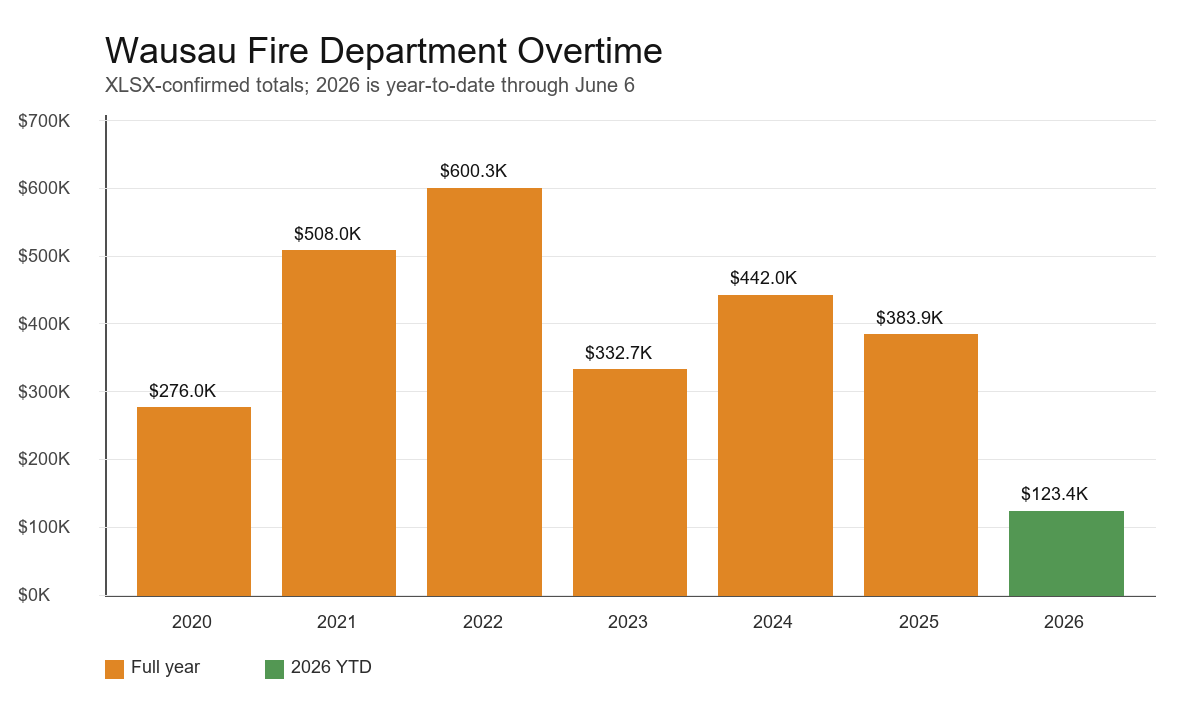
Wausau Fire Department’s overtime looks similar, with some caveats.
The department, which hadn’t changed staffing levels since the 1970s despite a massive increase in call volumes (particularly on the medical side), was approved to hire first three new firefighter-paramedics, then another nine, in mid-2022.
It seems likely that led to the decrease in overtime in 2023, the year after a peak of $600,000 in overtime spending in 2022. And like the police, the department is on track for its lowest overtime spending since at least 2020.
But spending in 2024 and 2025 increased again. Why?
The Wausonian first reached out to Chief Jeremy Kopp, but eventually connected with Deputy Chief Pleuss over the phone.
Pluess acknowledged that overtime peaked in 2022, when staffing levels were at their lowest as call volumes had continued to set records. The 12 new firefighters the city council approved took until 2023 to hire and train to full firefighter-paramedic levels.
Overtime decreased in 2023, but increased again as the department had more vacancies and trouble finding employees to replace them who had the qualifications and could handle the physical aspects of the job, Pleuss told The Wausonian.
There are reasons why fire department overtime might add up more quickly than other departments. Shifts are 24 hours, and if it’s two shifts that’s a full week’s worth of hours that need to be covered. Pleuss says they’re dividing into 12-hour blocks to be covered.
And according to the firefighter’s union contract The Wausonian reviewed, shifts are 48 hours on, 96 hours off, averaging no more than 56 hours per week. Overtime kicks in after that 56-hour cap.
And Barnes added that while sometimes if an officer goes home sick and there are a few hours left on the shift, the department can run short if it’s 3 am. But a fire crew might not be able to, because a minimum number of firefighters are required to be on staff in order to run an engine, for instance.
Public Works/Utilities
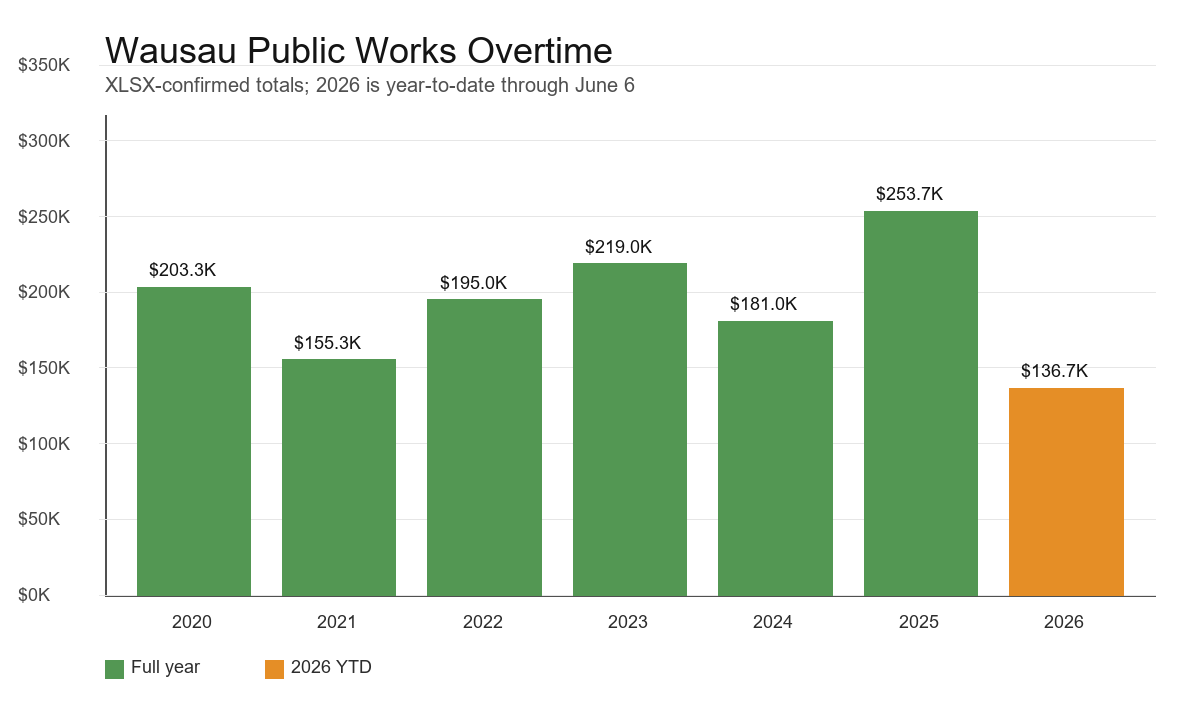
Public Works is a little different from the other departments in that in general, there is a slow upward trend. And unlike police and fire, Public Works seems on track to have another high year in overtime.
A lot of that likely came from some later-season snowstorms that set records. City crews worked double shifts and could only take a break before going back out for another shift. That can lead to a tremendous amount of overtime.
Public Works Director Eric Lindman in his memo to the HR committee spelled out the reasons for department overtime. While vacancies and leave for various reasons were also a factor, on top of the list was weather. Besides snowstorms, which are difficult to predict, storms, flooding and frozen water mains bring workers out after hours.
Why some employees made more than others
The overtime spending per department looks bad. But those top three are also the biggest departments by number of employees.
What happens when we look at overtime earnings per employee? And why doesn’t Human Resources have better visibility into overtime spending?
